The 2026-27 School Year in Essex County: NJ's Cell Phone Ban, AI Rules, and What NYC Families Should Know
By Sorelle Crooks, Realtor® | Real Broker LLC | NJ License #2185837
Published October 7, 2026 · Last updated October 7, 2026
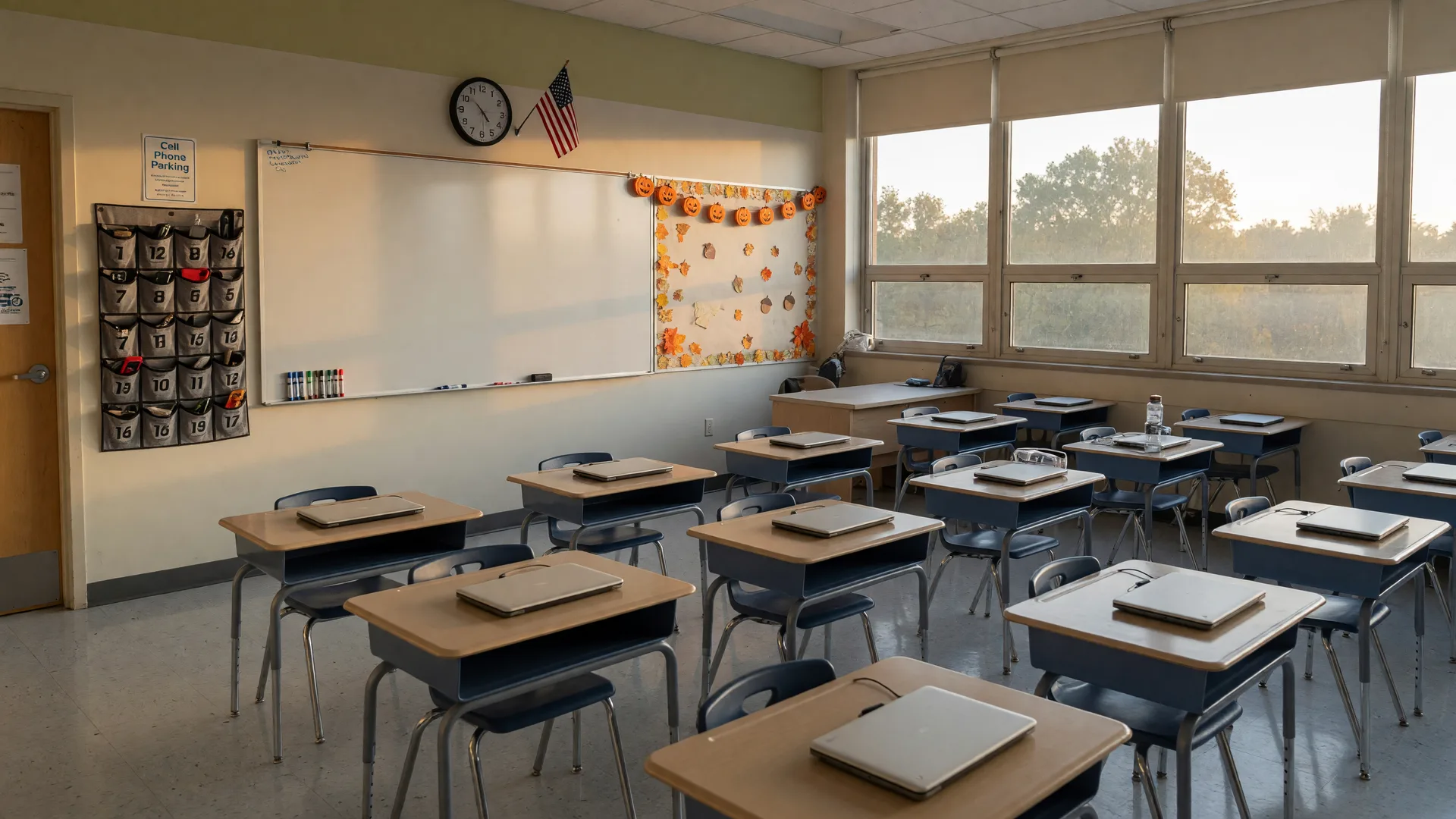
The 2026-27 school year brought the biggest device-policy change in a generation to New Jersey classrooms: a statewide bell-to-bell cell phone ban that applies to every public school district, including Bloomfield, West Orange, and Montclair. For families relocating from New York City, school policy is now part of the town-choice math, right alongside commute time and budget. Here is what the new rules actually do, how Essex County districts are rolling them out, and what to ask on a school tour.
I work with a lot of NYC families who are choosing between Essex County towns, and the honest truth is that schools drive more relocation decisions than any other single factor. The details below are the ones I want you to know before you compare towns.
- 1.The cell phone ban is statewide. New Jersey's bell-to-bell law now keeps students' non-academic phone use off during the school day in every public district, from the first bell to the last, including buses and school events.
- 2.Districts implement it differently. Each district picks its own storage approach, and Montclair has added new AI and Chromebook policies on top of the phone rules, so the policy details are worth asking about on every tour.
- 3.Budgets still matter. Montclair projects a small surplus but is not out of the woods, West Orange cut 77 staff positions, and Bloomfield built its budget after a $1.5 million state aid cut. School taxes are the largest share of most property tax bills.
What the bell-to-bell cell phone ban actually does
The measure, signed by then-Governor Phil Murphy, requires every public school district to adopt a policy that keeps students' non-academic use of phones and other internet-enabled devices off during the school day. It applies in classrooms, hallways, school buses, and at school-sponsored events, from the first bell to the last. Private schools are exempt.
The state has given districts four approved device-storage options, such as locked pouches or classroom storage, and each district writes its own implementation plan. That means the statewide requirement is the same everywhere, but the day-to-day experience can differ by town: one district might use locked pouches at the door, another might use classroom caddies, and the enforcement details are set locally. If you are comparing towns, this is exactly the kind of nuance worth asking about.
How Essex County districts are rolling it out
West Essex Regional, which serves students in grades 7 through 12 from North Caldwell, Roseland, and Essex Fells, updated its electronic device policy ahead of the school year with restricted use during instructional time, clearer consequences, and consistent enforcement across school levels. It is a good example of the direction most districts are taking.
Montclair went further. At its September 28, 2026 meeting, the Board of Education introduced two new policies spelling out how students may use AI tools, Chromebooks, and other technology in the classroom, a formal step after a district survey showed parents, students, and staff are uneasy about generative AI. The rules build on August guidance that sharply limited Chromebook use for the youngest students. For families weighing Montclair, my guide to Montclair schools for NYC families covers the district in full.
Bloomfield and West Orange are rolling out their own plans under the same state requirement. Asking "what is the district's device policy?" during a school tour is a quick, practical way to see how a school handles daily routines, and it tells you a lot about how deliberately the district communicates with families.
The budget backdrop: Montclair, West Orange, and Bloomfield
Policy changes are not happening in a vacuum, and the budget picture matters for families because school taxes are the largest share of most New Jersey property tax bills. Montclair is projecting a roughly $1 million surplus for 2026-27, the first positive sign since its deficit reached about $20 million, but the superintendent has said the district is absolutely not out of the woods, and a forensic audit is still underway. My post on the Montclair school budget for relocating families explains what the recovery means for buyers.
West Orange approved a 2026-27 budget that cuts 77 staff positions and eliminates all middle school sports to close a roughly $13.5 million deficit. For families, that is a real change in the day-to-day experience, and it is worth understanding before you fall in love with a house. My explainer on the West Orange school budget has the full story.
Bloomfield adopted an $89.4 million budget for 2026-27 after absorbing a $1.5 million state aid cut, and the district is one of eight in Essex County with a contested school board race this fall. If you are researching Bloomfield schools, my guide to Bloomfield schools for NYC parents walks through the district town by town.
What this means for homebuyers
Schools are one of the strongest drivers of where families choose to live, and device policy has become part of that conversation. A district that communicates its plan early and clearly tends to make the enrollment question easier for newcomers, and it is one more signal of how deliberately a town manages day-to-day school life. None of this changes the housing market on its own, but it is the kind of practical detail that makes a town feel like the right fit or not.
The market math is separate and just as important. Homes in Bloomfield, West Orange, and Montclair still sell over asking, so budget for the sale price, not the list price. In good condition, a turnkey single-family home realistically starts around $625K in Bloomfield, $600K in West Orange, and $900K in Montclair, and property taxes are part of the monthly cost in every town.
Pricing heads-up: Well-priced homes across these Essex County towns routinely attract multiple offers and close above list. Mid-October 2026 reads: Bloomfield (07003) median sale price ~$619K (RealtyTrac September read nearer ~$683K), homes selling ~6-12% above list on average (single-family in good condition from ~$625K); West Orange (07052) median ~$656K, homes selling ~6-9% above list on average (single-family in good condition from ~$600K); Montclair (07042) median ~$1.2M-$1.3M, homes selling ~20-25% above list on average (single-family in good condition from ~$900K, into the millions in Upper Montclair). Inventory is limited in each ZIP, so prepared buyers who budget for the sale price rather than the list price are best positioned. Every situation is different. Let's talk through what the latest numbers mean for yours.
The bottom line
The 2026-27 school year brought real changes to Essex County classrooms: a statewide cell phone ban, new AI and technology policies in Montclair, and budget realities in every district. For NYC families choosing a town, the right questions are the practical ones: what is the device policy, how does the district communicate, and what does the budget mean for the next few years?
If you want to talk through which Essex County town fits your family, your commute, and your budget, I am happy to walk through the pros and cons with you. No pressure, just honest local guidance.
Talk soon,
Sorelle
Keep Reading
Comparing Essex County schools and towns? Let's look at the numbers together.