Essex-Hudson Greenway Breaks Ground: What It Means for Essex County

Public voting to name the new park closed on June 29, 2026. The four name options were: Prosperity State Park, Ridge Public voting to name the new park closed on June 29, 2026. The four name options were: Prosperity State Park, Ridge & River State Park, Ironline State Park, and Steel Trail State Park. The NJ Department of Environmental Protection is reviewing the results. Meanwhile, construction continues on the Newark segment, and a volunteer cleanup event in Bloomfield drew 50 volunteers in April 2026 – a sign of growing community investment in the project's future.amp; River State Park, Ironline State Park, and Steel Trail State Park. The NJ Department of Environmental Protection is reviewing the results. Meanwhile, construction continues on the Newark segment with the first phase expected to open by end of 2026. Community visioning sessions are underway for the Glen Ridge and Bloomfield segments as the project shifts focus west. The NJDEP released a comprehensive Vision Public voting to name the new park closed on June 29, 2026. The four name options were: Prosperity State Park, Ridge & River State Park, Ironline State Park, and Steel Trail State Park. The NJ Department of Environmental Protection is reviewing the results. Meanwhile, construction continues on the Newark segment, and a volunteer cleanup event in Bloomfield drew 50 volunteers in April 2026 – a sign of growing community investment in the project's future.amp; Action Plan in early 2026 serving as the strategic blueprint for developing the remaining eight miles of the 9-mile corridor. A volunteer cleanup event in Bloomfield drew 50 volunteers in April 2026, a sign of growing community investment in the project. I am continuing to track progress and will update this story as new segments move forward.
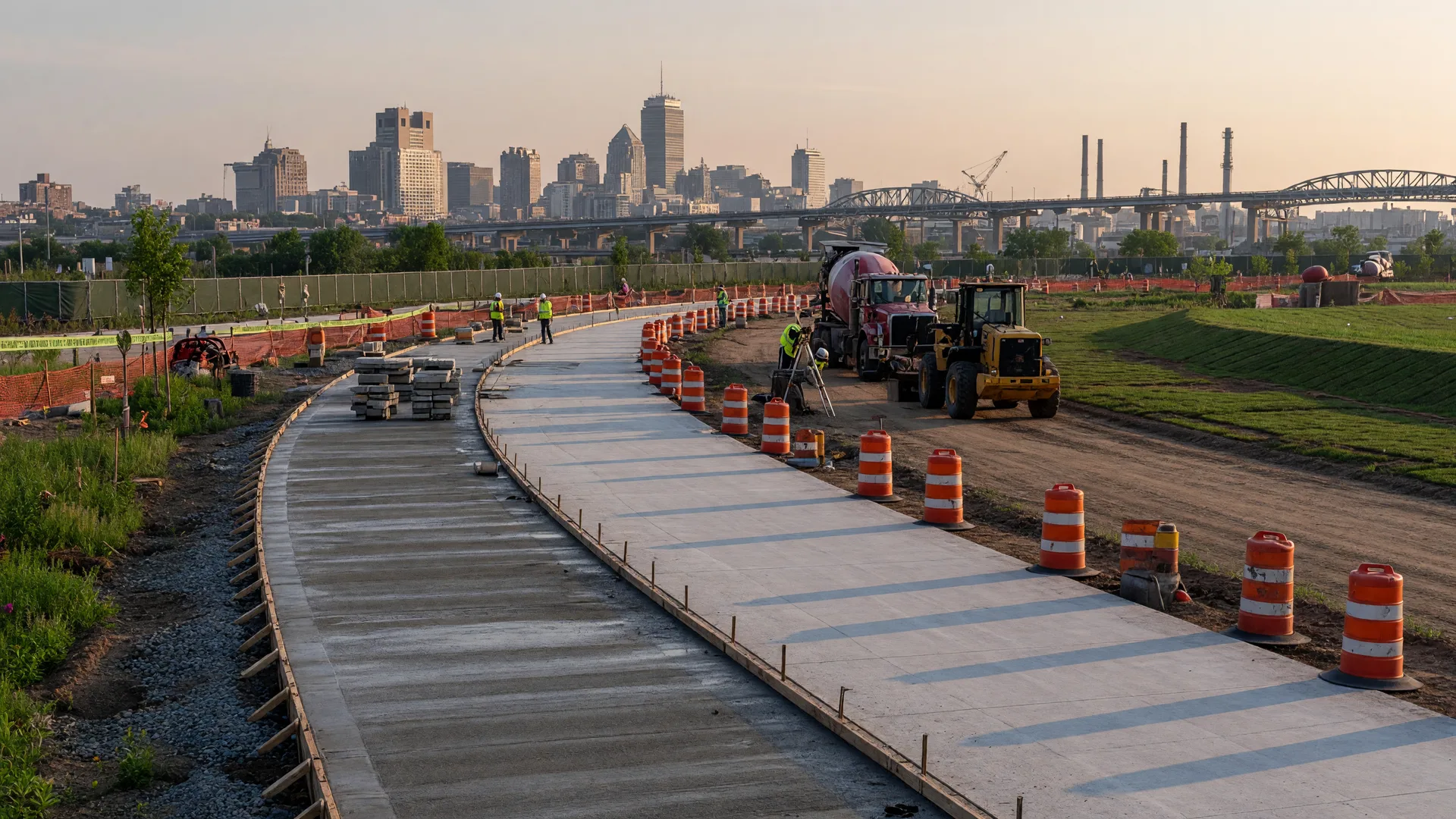
One of the most significant infrastructure projects in Essex County history officially broke ground in July 2025. The Essex-Hudson Greenway – a plan to convert a nine-mile former rail line into a public state park and multi-use trail – moved from concept to construction when Governor Phil Murphy and local officials cut the ribbon on the first phase in Newark.
If you live in Montclair, Bloomfield, or anywhere along the corridor, this project is worth understanding. It's the kind of long-term investment that can genuinely reshape how a region connects, moves, and – for homeowners – how property values trend over time.
What is the Essex-Hudson Greenway?
The Greenway is a plan to transform a disused, overgrown rail corridor – the former Lehigh Valley Railroad right-of-way – into a 100-foot-wide linear state park. The trail will stretch approximately nine miles from Montclair through Bloomfield, Glen Ridge, Belleville, Newark, Kearny, and Secaucus, eventually connecting to Jersey City and the Hudson County waterfront.
Think of it as Northern New Jersey's answer to the High Line in Manhattan or the Capital Crescent Trail in the D.C. area – a car-free path for walking, running, and biking that connects communities and neighborhoods that the rail corridor currently divides.
What happened at the groundbreaking?
In July 2025, Governor Murphy joined local officials in Newark to kick off construction on the first phase – a nearly one-mile segment between Branch Brook Drive and Broadway in Newark. This initial phase represents a $69.2 million investment, described as the largest single investment in New Jersey history for a new state park.
The Newark segment is expected to open by the end of 2026. After that, construction will proceed in phases along the rest of the corridor, moving through the other municipalities toward the waterfront.
July 2026 update: What's happened since the groundbreaking?
It's been about a year since the groundbreaking, and here's where things stand:
- Construction continues in Newark. Work on the initial one-mile Newark segment has been progressing through 2026. This first phase remains the only section actively under construction.
- The NJDEP released a Vision & Action Plan in January 2026. This document lays out the framework for planning the remaining eight miles of the Greenway – including the sections that pass through Bloomfield, Montclair, Glen Ridge, and Belleville. It's a significant milestone because it moves the western segments from "idea" to "planned."
- Community visioning sessions are underway. The NJDEP has been hosting public "visioning sessions" for the Greenway West section – the stretch that runs through Montclair, Glen Ridge, Bloomfield, and Belleville. These sessions are designed to gather community input on trail design, access points, and how the Greenway connects to existing neighborhoods.
- No specific completion date yet for the Bloomfield/Montclair segments. The West section is still in the planning and design phase. Based on the project's phased approach, these segments will follow after the Newark section opens – but a precise timeline hasn't been announced.
The bottom line on timing: if you're a homeowner in Bloomfield or Montclair hoping to walk or bike on the Greenway from your neighborhood, it's coming – but it's still a few years out. The Newark section opening by end of 2026 will be the first tangible proof of concept, and momentum should build from there.
Which towns does it pass through?
The Greenway route runs through eight municipalities:
- Montclair – the eastern terminus of the corridor
- Bloomfield – a significant stretch of the route runs through the township
- Glen Ridge
- Belleville
- Newark – the first phase of construction
- Kearny
- Secaucus
- Jersey City – the western terminus connecting to the Hudson waterfront
For homeowners in Montclair and Bloomfield specifically, this means a major new recreational amenity is being built in your backyard – one that will connect your neighborhood to a regional trail network.
What does this mean for homeowners?
Trail-adjacent properties in other markets have seen measurable value increases once similar greenway projects are completed. While it's too early to cite specific numbers for the Essex-Hudson Greenway, the pattern is well-documented: communities with access to quality green space, walking trails, and car-free transportation corridors tend to attract buyers and support stronger property values over time.
Here's what I'd watch for:
- Property values near the trail corridor. As the Greenway gets built section by section, homes within walking or biking distance of trail access points could see increased buyer interest – particularly from commuters, families, and fitness-minded buyers who value walkability.
- Transit connections. The Greenway is designed to connect with NJ Transit stations along the route, creating a multi-modal transportation option. That kind of connectivity matters to buyers relocating from NYC or looking for reduced car dependency.
- Local business impact. Trail users stop for coffee, food, and shopping. In other greenway markets, nearby small businesses have seen increased foot traffic once trails open.
- Neighborhood character. The rail corridor has been an eyesore and a dividing line for decades. Converting it to a park fundamentally changes the feel of adjacent neighborhoods – for the better, in most cases.
What does this mean for buyers?
If you're looking at homes in Montclair, Bloomfield, or other towns along the Greenway route, the project adds a new variable to consider. Proximity to future trail access points could become a selling point – and a factor in long-term value appreciation.
That said, the full Greenway won't be built overnight. The Newark phase is expected to open by end of 2026, but the remaining segments will take years to complete. If you're buying now, it's worth understanding the timeline and what's planned for the section nearest any property you're considering.
The bottom line
The Essex-Hudson Greenway is one of the most ambitious public infrastructure projects in New Jersey – and it runs right through the heart of Essex County. For homeowners along the corridor, it's a long-term positive that could support property values, quality of life, and neighborhood connectivity. For buyers, it's a reason to pay attention to the Montclair-Bloomfield corridor as a place to put down roots.
I'll be tracking construction progress as the Greenway moves through its phases. If you have questions about how the project might affect a specific property or neighborhood, I'm always happy to talk through it.
Sources
This story is based on reporting by Montclair Local, The Observer, Patch, and the NJ Department of Environmental Protection (July 2025).
Have a tip about local development?
I cover local real estate and development news across Bloomfield, West Orange, Montclair, and Essex County. If you hear about new construction, zoning changes, or neighborhood issues, I'd love to hear about it.